
Australia depends on reliable water storage more than most countries. From rural farming operations and commercial developments to mining sites, industrial facilities, and civil infrastructure, a properly engineered water storage system is critical for operational continuity, water security, and regulatory compliance.
Yet, many water tank projects in Australia fail long before they reach their expected service life. Tanks develop structural cracks, leak unexpectedly, corrode prematurely, experience excessive settlement, or require expensive repairs within only a few years of installation. In many cases, these failures aren’t caused by poor materials – they begin with avoidable engineering and planning mistakes made before construction even starts.
According to Australian infrastructure and engineering best practices, the lifespan of a water storage system depends on far more than the tank itself. Factors such as site assessment, foundation design, structural engineering, hydraulic performance, corpliance with Australian Standards, and construction quality assurance collectively determine whether a project performs for decades – or becomes a costly liability.
For property owners, councils, developers, agricultural businesses, and industrial operators, these mistakes can translate into:
- Project cost overruns
- Water loss and operational downtime
- Structural failures
- Increased maintenance costs
- Insurance complications
- Reduced asset lifespan
- Safety and environmental risks
This is why experienced engineering partners like Armstrong Tanks place equal emphasis on Water Tank Project Planning, Water Storage Engineering Australia, and long-term asset performance – not simply supplying a tank.
Why Do Water Tank Projects Fail in Australia?
Water tank projects usually fail because engineering decisions made during planning don’t match real-world site conditions, operational requirements, or long-term structural demands.
The tank itself is rarely the problem.
Instead, failures typically originate from:
- Inadequate site investigations
- Incorrect foundation design
- Poor engineering calculations
- Low-quality installation practices
- Ignoring environmental loads
- Selecting the wrong storage solution
- Lack of lifecycle planning
In Australia’s highly variable climate and soil conditions, every project should be treated as a unique engineering challenge rather than a standard construction job.
Expert Definition:
A successful water storage project is not defined by the completion of installation – it is measured by decades of safe, efficient, and low-maintenance operation.
The 17 Engineering Mistakes That Cause Water Tank Project Failure
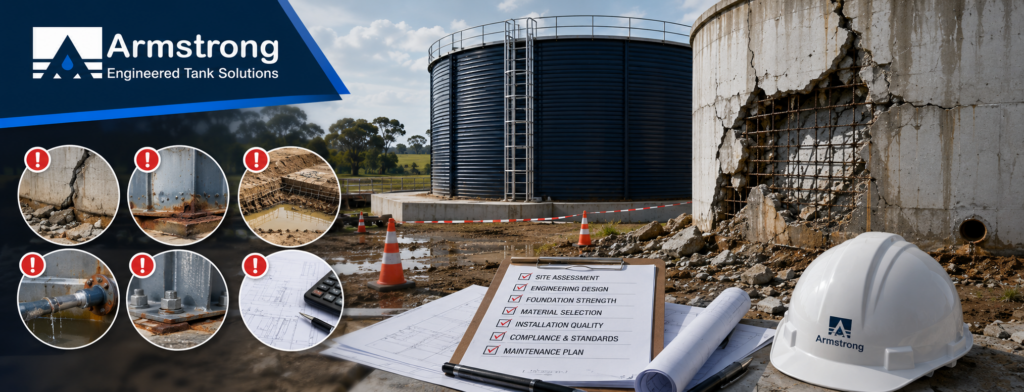
Mistake #1 – Skipping a Professional Site Assessment
Every successful project begins with understanding the land.
Unfortunately, many projects assume the site is “good enough” without conducting a comprehensive Water Tank Site Assessment.
This shortcut often leads to:
- Uneven settlement
- Drainage problems
- Structural movement
- Foundation cracking
- Increased maintenance costs
Why Site Assessment Matters
Professional engineers evaluate:
- Existing ground levels
- Drainage patterns
- Flood exposure
- Access for heavy equipment
- Nearby infrastructure
- Groundwater conditions
- Soil bearing capacity
Ignoring these factors can dramatically increase project risk before construction even begins.
What is a water tank site assessment?
A water tank site assessment is an engineering evaluation that determines whether the proposed location can safely support the tank throughout its operational lifespan while accounting for soil conditions, drainage, environmental loads, and future maintenance access.
Mistake #2 – Ignoring Geotechnical Investigation
One of the most expensive mistakes in Water Tank Construction is assuming the ground beneath the tank is stable.
Australia contains highly variable soil conditions, including:
- Reactive clay
- Expansive soils
- Sandy coastal soils
- Fill material
- Rock formations
- Soft alluvial deposits
Without a proper Geotechnical Investigation, engineers cannot accurately determine:
- Site Classification
- Soil Conditions
- Foundation Settlement risk
- Load-bearing capacity
- Compaction requirements
Why This Matters
A tank holding hundreds of thousands – or even millions – of litres exerts tremendous vertical loads.
Even slight differential settlement may result in:
- Cracked concrete foundations
- Misaligned pipework
- Structural distortion
- Joint failures
- Water leakage
This is why experienced Structural Engineering teams treat geotechnical reports as essential design inputs rather than optional documentation.
Mistake #3 – Poor Water Tank Foundation Design
A high-quality tank cannot compensate for a poorly designed foundation.
Whether the project involves Steel Tanks, Concrete Tanks, or Large Water Storage Tanks Australia, the foundation transfers enormous structural loads safely into the ground.
Common Foundation Errors
- Incorrect slab thickness
- Poor reinforcement detailing
- Inadequate compaction
- Uneven base preparation
- Insufficient drainage
- Ignoring groundwater movement
Consequences
Poor Water Tank Foundation Design often causes:
- Settlement
- Tilting
- Base cracking
- Increased Hydrostatic Pressure
- Structural instability
Best Practice
Foundation design should always consider:
- Tank diameter
- Water depth
- Dead load
- Live load
- Wind Loading
- Seismic Design
- Soil classification
Proper engineering at this stage significantly improves Tank Longevity while reducing lifecycle maintenance costs.
Mistake #4 – Choosing the Wrong Tank Material
Many buyers focus primarily on initial purchase price.
However, selecting between Steel Tank Engineering and Concrete Tank Engineering should always depend on operational requirements – not cost alone.
Different projects demand different engineering solutions.
| Project Type | Steel Tanks | Concrete Tanks |
| Fast installation | Excellent | Moderate |
| Very large storage | Excellent | Excellent |
| Fire water storage | Excellent | Excellent |
| Potable water storage | Excellent | Excellent |
| Long-term durability | Excellent | Excellent |
| Custom engineering | Excellent | Excellent |
The Better Question Isn’t “Which Is Better?”
Instead ask:
Which storage solution is engineered for this site’s specific operational needs?
The answer depends on:
- Storage capacity
- Water quality
- Expansion plans
- Budget
- Site conditions
- Maintenance strategy
- Project lifecycle
Companies like Armstrong Tanks evaluate these variables before recommending Custom Water Storage Solutions, ensuring the chosen system aligns with the client’s operational goals rather than a one-size-fits-all approach.
Mistake #5 – Underestimating Hydrostatic Pressure
Water appears harmless.
From an engineering perspective, it creates enormous forces.
As storage depth increases, Hydrostatic Pressure rises significantly against:
- Tank walls
- Floor slabs
- Connections
- Pipe penetrations
Why It Matters
Poor engineering calculations can result in:
- Wall deformation
- Joint failures
- Excessive stress
- Leakage
- Structural fatigue
For Industrial Water Tank Design, Commercial Water Storage Projects, and Mining Water Storage Systems, accurate hydraulic and structural analysis is fundamental to long-term reliability.
Why do water tanks leak?
Most water tanks leak because of structural movement, failed joints, poor foundation performance, corrosion, or incorrect engineering that fails to account for hydrostatic pressure over time.
Mistake #6 – Overlooking Corrosion Protection
Australia presents some of the world’s harshest operating environments.
Depending on location, tanks may face:
- Coastal salt exposure
- High UV radiation
- Industrial chemicals
- Agricultural environments
- Extreme temperature variation
- Seasonal rainfall
Without appropriate Corrosion Protection, even well-designed systems may experience premature deterioration.
Effective Protection Includes
- Protective coatings
- Galvanisation
- Cathodic protection (where appropriate)
- Regular inspections
- Preventive Maintenance programs
- Water quality monitoring
For Bolted Steel Construction, corrosion management should be integrated into the engineering design from the outset rather than treated as an afterthought.
Expert Insight: Engineering Determines Asset Value – Not Just Construction Quality
Many failed water storage projects are incorrectly blamed on the tank manufacturer. In reality, the majority of failures stem from decisions made during planning, design, and installation rather than the tank itself.
A well-engineered system combines geotechnical investigation, structural engineering, foundation design, hydraulic engineering, and construction quality assurance into a single, coordinated process. This integrated approach minimizes project risk, extends asset lifespan, and delivers a lower life cycle cost over decades of operation.
For organisations investing in Water Infrastructure Australia, the most valuable decision is often selecting an engineering partner with proven expertise across the entire project lifecycle – not simply comparing upfront costs.
Mistake #7 – Ignoring Australian Water Tank Standards and Engineering Compliance
Every successful Water Tank Construction project begins with compliance – not after construction, but during the earliest stages of planning and design.
Australia has stringent engineering requirements covering structural integrity, public safety, potable water quality, and environmental performance. Overlooking these standards can result in redesigns, certification delays, costly rectification work, or even complete project failure.
Why Engineering Compliance Matters
Professional engineers consider:
- Applicable Australian Water Tank Standards
- Building and planning approvals
- Structural design requirements
- Water quality regulations
- Environmental obligations
- Occupational health and safety requirements
Compliance isn’t simply about passing inspections. It ensures the storage system performs safely throughout its intended service life.
Why are Australian Standards important for water tanks?
Australian Standards help ensure water tanks are designed, manufactured, installed, and maintained to achieve long-term safety, durability, structural performance, and regulatory compliance.
Mistake #8 – Designing for Today’s Demand Instead of Tomorrow’s Growth
One of the most common planning mistakes is sizing a tank based only on current water consumption.
However, water demand rarely remains static.
Future growth may include:
- Business expansion
- Additional irrigation zones
- New production facilities
- Increased livestock numbers
- Higher fire protection requirements
- Population growth
- Climate variability
Installing an undersized tank often leads to expensive upgrades that could have been avoided through better Water Tank Project Planning.
Ask These Questions Early
- Will storage demand increase within five years?
- Is expansion likely?
- Will rainfall patterns change?
- Could regulations require larger emergency reserves?
Forward-thinking engineering protects long-term infrastructure investment.
Mistake #9 – Poor Fire Water Tank Design
Across Australia, reliable Fire Water Storage is becoming increasingly important due to longer bushfire seasons and stricter fire protection requirements.
Unfortunately, some projects treat fire storage as an afterthought.
Common Design Problems
- Insufficient reserve capacity
- Poor pump accessibility
- Incorrect outlet positioning
- Shared domestic supply without proper separation
- Limited emergency vehicle access
For commercial and industrial developments, these mistakes can affect emergency response capability.
Best Practice
A properly engineered Fire Water Tank Design should consider:
- Required reserve volume
- Pump performance
- Future expansion
- Reliable access
- Maintenance requirements
- Local fire authority expectations
Reliable Bushfire Water Supply isn’t simply about installing a larger tank – it requires integrated engineering.
Mistake #10 – Poor Hydraulic Engineering
Many tank failures aren’t structural.
Instead, they occur because the hydraulic system was poorly designed.
Common Hydraulic Issues
- Incorrect pipe sizing
- Poor inlet design
- Inadequate overflow capacity
- Air locking
- Sediment accumulation
- Pump cavitation
These issues reduce operational efficiency and increase maintenance costs.
Professional Hydraulic Engineering ensures water moves efficiently while protecting the storage asset.
Which engineering factors matter most?
Successful projects depend on structural engineering, hydraulic engineering, geotechnical investigation, foundation design, environmental assessment, and lifecycle planning working together.
Mistake #11 – Overlooking Environmental and Climate Conditions
Australia presents some of the world’s most demanding operating environments.
Every project should account for:
- Extreme heat
- UV exposure
- Bushfire risk
- Heavy rainfall
- Flooding
- High winds
- Coastal salt spray
- Extended drought
Ignoring environmental factors shortens asset life and increases maintenance requirements.
Climate Resilience Is Now Essential
Modern Water Storage Engineering Australia focuses on:
- Sustainable Infrastructure
- Water Security
- Environmental Engineering
- Climate Resilience
- Long-term operational reliability
Infrastructure designed for today’s climate alone may not perform adequately over the next 30 to 50 years.
Mistake #12 – Poor Construction Quality Assurance
Even the best engineering design can fail if construction quality isn’t properly managed.
Common Construction Errors
- Incorrect bolt torque
- Poor concrete curing
- Misaligned panels
- Inferior waterproofing
- Poor weld quality
- Inadequate reinforcement placement
Quality assurance should occur throughout construction – not only during final inspection.
Effective QA Includes
- Material verification
- Dimensional checks
- Inspection hold points
- Engineering reviews
- Commissioning inspections
- Documentation
Strong Construction Quality Assurance protects both project performance and long-term reliability.
Mistake #13 – Choosing Lowest Cost Instead of Lowest Life Cycle Cost
Many buyers compare only installation prices.
However, the cheapest project often becomes the most expensive over time.
Initial Cost vs Life Cycle Cost
| Lowest Price Focus | Life Cycle Cost Focus |
| Lower upfront investment | Lower total ownership cost |
| More maintenance | Reduced maintenance |
| Earlier repairs | Longer service life |
| Higher operational risk | Greater reliability |
| Short-term savings | Long-term value |
Professional engineers evaluate the Asset Lifecycle, not simply procurement costs.
A higher-quality system may reduce maintenance and replacement expenses for decades.
Expert Insight: The most economical water tank is rarely the cheapest to buy – it’s the one that delivers the lowest total cost across its entire operational life.
Mistake #14 – Ignoring Preventive Maintenance
Even outstanding engineering requires routine maintenance.
Unfortunately, many owners wait until problems become visible.
By then, repairs are often significantly more expensive.
Preventive Maintenance Should Include
- Structural inspections
- Roof inspections
- Internal cleaning
- Coating assessment
- Corrosion monitoring
- Pipework inspection
- Valve testing
- Leak detection
Routine maintenance extends Tank Longevity, protects water quality, and reduces operational downtime.
What affects water tank lifespan?
Water tank lifespan depends on engineering design, foundation performance, corrosion protection, environmental exposure, maintenance practices, water quality, and construction quality.
Mistake #15 – Failing to Integrate Water Storage into the Bigger Infrastructure Plan
A water tank should never be viewed as a standalone asset.
Instead, it forms part of a broader infrastructure network that may include:
- Pump stations
- Irrigation systems
- Fire protection infrastructure
- Treatment equipment
- Distribution pipelines
- Monitoring systems
- Future storage expansion
Poor integration creates operational inefficiencies and unnecessary future costs.
Successful Water Infrastructure Planning considers the complete system – not just the storage vessel.
Mistake #16 – Using Standard Designs for Complex Projects
No two sites are identical.
Yet many projects still rely on standard tank designs without considering operational requirements.
This is particularly risky for:
- Commercial Water Storage Projects
- Industrial Water Tank Design
- Mining Water Storage Systems
- Civil Water Storage Projects
- Agricultural Water Infrastructure
Each sector has unique engineering demands relating to loading, access, water quality, operational cycles, and future expansion.
Why Custom Engineering Matters
Custom Water Storage Solutions allow engineers to optimise:
- Storage capacity
- Structural performance
- Operational efficiency
- Maintenance access
- Future scalability
- Whole-of-life cost
This tailored approach reduces project risk while improving long-term performance.
Mistake #17 – Selecting a Supplier Instead of an Engineering Partner
Perhaps the biggest mistake is treating a water storage project as a simple product purchase.
Large-scale water storage is an engineering project – not just a tank installation.
The right partner should contribute expertise throughout the project lifecycle, including:
- Feasibility assessment
- Site investigation
- Engineering design
- Material selection
- Manufacturing
- Installation support
- Compliance guidance
- Maintenance planning
Companies like Armstrong Tanks focus on delivering integrated Water Storage Solutions that combine Steel Tanks, Concrete Tanks, and Custom Engineered Tanks with engineering expertise tailored to Australia’s diverse operating environments.
For projects involving Commercial Water Tanks Melbourne, Industrial Water Storage Victoria, Water Tank Projects Victoria, or Rural Water Storage Victoria, this collaborative approach helps minimise risk and maximise long-term asset performance.
Steel Tanks vs Concrete Tanks: Which Is Right for Your Project?
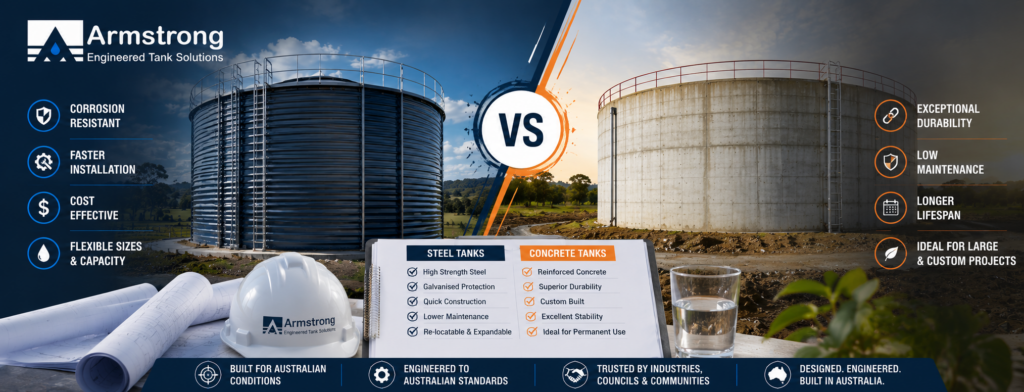
| Consideration | Steel Tanks | Concrete Tanks |
| Installation Speed | Faster on many sites | Longer construction period |
| Large Capacity Storage | Excellent | Excellent |
| Custom Engineering | Highly flexible | Highly flexible |
| Corrosion Management | Requires protective systems | Naturally resistant but requires crack management |
| Structural Performance | Strong with engineered bolted or welded systems | Excellent mass and durability |
| Maintenance Strategy | Coating inspections and protection | Joint, crack, and waterproofing inspections |
| Typical Applications | Industrial, commercial, mining, fire water, agriculture | Municipal, civil infrastructure, potable water, long-term storage |
There is no universally “better” option. The ideal choice depends on project objectives, site conditions, lifecycle expectations, operational requirements, and engineering constraints.
Expert Insight: Engineering Is the Best Form of Risk Management
Successful Large Water Storage Tanks Australia are built on informed engineering decisions – not assumptions.
Projects that invest in detailed Structural Engineering, Geotechnical Investigation, Project Risk Management, Engineering Compliance, and Construction Quality Assurance consistently achieve:
- Longer operational life
- Lower maintenance costs
- Greater water security
- Improved infrastructure resilience
- Better return on infrastructure investment
“The strongest water tank is not defined by the thickness of its walls, but by the quality of the engineering decisions made before the first foundation is poured.”
Common Mistakes Checklist
Before approving any water storage project, ask whether your team has:
- Completed a professional site assessment.
- Conducted a geotechnical investigation.
- Designed foundations for actual soil conditions.
- Selected the most appropriate tank material.
- Accounted for hydrostatic pressure and hydraulic performance.
- Incorporated corrosion protection strategies.
- Ensured compliance with Australian Standards.
- Planned for future capacity requirements.
- Integrated fire water storage needs.
- Considered climate resilience and environmental exposure.
- Implemented construction quality assurance.
- Evaluated whole-of-life costs.
- Established a preventive maintenance program.
- Integrated the tank into the wider infrastructure network.
- Chosen a custom-engineered solution where required.
- Partnered with experienced engineering specialists.
Addressing each of these areas dramatically improves the likelihood that your investment will deliver reliable, efficient water storage for decades.
Key Takeaways
If there’s one lesson to take from these 17 engineering mistakes, it’s this: a water tank is only as reliable as the planning and engineering behind it.
Whether you’re developing a commercial facility in Melbourne, expanding an agricultural property in Regional Victoria, or delivering a major civil infrastructure project, long-term success depends on making informed decisions before construction begins.
Remember these critical principles:
- Invest in professional Water Tank Project Planning from the outset.
- Conduct a detailed Water Tank Site Assessment and Geotechnical Investigation.
- Design foundations based on actual Soil Conditions and structural loads.
- Select between Steel Tanks and Concrete Tanks based on engineering requirements – not just initial cost.
- Consider Hydrostatic Pressure, Wind Loading, Seismic Design, and environmental exposure.
- Build for future growth, climate resilience, and operational flexibility.
- Prioritise Construction Quality Assurance and ongoing Preventive Maintenance.
- Partner with an experienced engineering company that understands Australia’s unique infrastructure challenges.
When these principles are followed, a water storage system becomes more than a tank – it becomes a long-term infrastructure asset that protects water security, reduces operating costs, and delivers dependable performance for decades.
Expert Insight: Engineering Is an Investment, Not an Expense
Many organisations focus on reducing upfront construction costs. However, the most successful infrastructure owners evaluate projects through the lens of asset lifecycle performance.
A well-engineered water storage solution can provide:
- Lower maintenance expenditure
- Greater operational reliability
- Improved regulatory compliance
- Reduced environmental risk
- Better return on infrastructure investment
- Longer service life
“The true cost of a water tank isn’t measured on installation day – it’s measured over the next 30 to 50 years of operation. Smart engineering consistently delivers the lowest total cost of ownership.”
This philosophy is central to leading infrastructure projects across Water Infrastructure Australia, where resilience, compliance, and lifecycle value matter as much as construction quality.
Why Armstrong Tanks Is the Engineering Partner of Choice
Choosing the right water storage partner goes beyond selecting a tank supplier. It means working with a team that understands the engineering, operational, and regulatory factors that influence long-term performance.
Armstrong Tanks delivers integrated Water Storage Solutions for projects across Victoria and Australia, combining engineering expertise with decades of industry experience.
Comprehensive Capabilities
- Custom Steel Tanks
- Engineered Concrete Tanks
- Large-scale commercial and industrial storage
- Agricultural and rural water storage systems
- Fire water storage infrastructure
- Potable water storage systems
- Civil and municipal water storage projects
- Bespoke engineering for complex applications
Why Property Owners and Project Managers Choose Armstrong Tanks
- Engineering-led project approach
- Custom-designed storage solutions
- Compliance with Australian Standards
- Expertise across diverse industries
- Focus on durability, safety, and lifecycle value
- Proven experience in large-scale infrastructure projects
Whether you’re planning Commercial Water Tanks Melbourne, Industrial Water Storage Victoria, Water Tanks Geelong, Water Tanks Gippsland, Water Tanks Morwell, Water Tanks Ballarat, Water Tanks Moe, Water Tanks Bendigo, Water Tanks Ararat, Water Tanks Castlemaine, or Water Tanks Regional Victoria, Armstrong Tanks provides tailored engineering solutions designed for long-term performance.
Ready to Build a Water Storage System That Lasts?
Every successful project starts with the right engineering decisions.
If you’re planning a new Commercial Water Storage Project, expanding Agricultural Water Infrastructure, or upgrading an existing Industrial Water Storage system, expert guidance during the planning stage can prevent costly mistakes and maximise long-term value.
Talk to Armstrong Tanks About Your Water Storage Project
Work with experienced engineers to design a water storage solution tailored to your site, operational requirements, and long-term objectives. From initial planning through installation and ongoing performance, Armstrong Tanks helps you build infrastructure that stands the test of time.
Frequently Asked Questions
1. Why do water tank projects fail in Australia?
Most water tank projects fail due to inadequate planning, poor site assessment, incorrect foundation design, unsuitable material selection, insufficient engineering, and lack of long-term maintenance. Environmental conditions, regulatory compliance, and construction quality also play significant roles in determining project success.
2. What causes steel water tanks to fail?
Steel water tanks typically fail because of corrosion, inadequate protective coatings, poor foundation performance, incorrect structural design, excessive hydrostatic pressure, or improper installation. Regular inspections and preventive maintenance significantly extend their lifespan.
3. Why do concrete water tanks crack?
Concrete tanks may crack due to foundation settlement, poor reinforcement detailing, shrinkage, inadequate curing, excessive loading, or reactive soil movement. Professional structural engineering and geotechnical investigation help minimise these risks.
4. How do you choose the right water storage system?
The ideal water storage solution depends on water demand, site conditions, intended application, environmental exposure, future expansion, maintenance strategy, and budget. A professional engineering assessment ensures the selected system aligns with operational and regulatory requirements.
5. What mistakes should be avoided when installing a water tank?
Common installation mistakes include skipping site investigations, under-designing foundations, ignoring Australian Standards, poor pipework integration, inadequate drainage, insufficient corrosion protection, and failing to plan for future capacity.
6. How long should a commercial water tank last?
A properly engineered and maintained commercial water tank can last 30 to 50 years or more, depending on its construction material, operating environment, maintenance practices, and engineering quality.
7. Which engineering factors matter most for long-lasting water tanks?
The most critical engineering factors include:
- Site assessment
- Geotechnical investigation
- Foundation design
- Structural engineering
- Hydraulic engineering
- Corrosion protection
- Engineering compliance
- Construction quality assurance
- Preventive maintenance
- Lifecycle planning
Together, these elements determine the safety, reliability, and longevity of the entire water storage system.
Final Thoughts
As Australia’s demand for reliable water infrastructure continues to grow, successful projects will increasingly depend on engineering excellence rather than simply larger storage capacity.
Whether supporting Rainwater Harvesting, Bushfire Water Supply, Industrial Water Storage, Agricultural Water Infrastructure, or Civil Infrastructure, every water storage project represents a long-term investment in resilience and sustainability.
By avoiding the 17 engineering mistakes outlined in this guide and partnering with experienced specialists such as Armstrong Tanks, property owners can reduce project risks, improve operational efficiency, and maximise the return on their infrastructure investment for decades to come.